The Man Who Hid in a Roman Jar: A 1,600-Year-Old Last Stand at Deultum

AI-generated historical reconstruction. It is not an authentic ancient image.
What would you do if an enemy attack reached the city, fire was spreading through the buildings, and there was nowhere left to run?
At Deultum, an ancient Roman colony in southeastern Bulgaria, one young man appears to have climbed inside a giant storage jar and tried to disappear.
He never came out.
In 2026, archaeologists uncovered his skeleton inside the vessel, along with two iron knives, in the northern turret of the city’s western gate. Around him were signs of a violent fire: ash, melted glass, blackened masonry, and other evidence of destruction.
The discovery offers a rare and unsettling glimpse of an ordinary person caught in a period of war and collapse. It is also a reminder that some of the most powerful forgotten history stories are not about emperors or generals: but about people making desperate choices in their final moments.
Deultum: Rome’s colony on the edge of danger
Deultum, also known as Develtos or Develt, stood near the mouth of the Sredetska River in what is now southeastern Bulgaria.
The settlement was founded in the first century AD under Emperor Vespasian. It became a Roman colony for military veterans, including former soldiers associated with Legio VIII Augusta. For centuries, Deultum was an important urban and commercial centre in the region.
But the Roman world changed dramatically during Late Antiquity.
The rise of Constantinople transformed the military importance of the Balkans. Settlements that had once been prosperous provincial cities increasingly became fortified positions along vulnerable routes. Deultum was surrounded by walls, gates, towers, and defensive structures.
By the fourth and fifth centuries, the city was living in a more dangerous world. Gothic groups, other East Germanic peoples, and later the Huns placed increasing pressure on Roman settlements across the Balkans.
Deultum experienced repeated destruction during these centuries. Archaeologists have identified evidence of fires, rebuilding, attacks, and other disasters. The man in the jar appears to have died during one of these violent episodes.
However, the identity of the attackers remains uncertain.
Researchers have suggested that the destruction may be connected to an attack by Huns or East Germanic groups. That is historically plausible, but no evidence currently identifies a particular army or a specific battle. The connection should therefore be treated as a preliminary interpretation, not a proven fact.
The discovery inside the dolium
During excavations in 2026, archaeologists working in the northern turret of Deultum’s western gate encountered a huge ceramic storage vessel.
The vessel was a dolium: a large Roman container normally used to store goods such as grain, wine, oil, or other supplies. Some dolia were large enough to hold a person, although they were not designed as hiding places or burial containers.
Inside this one was a human skeleton.
The remains belonged to a young man, although the precise age and biological profile are still being assessed. His body was found in a tightly confined position, consistent with someone who had climbed into the vessel rather than being deliberately placed there as part of a formal burial.
Two iron knives were also associated with him. Reports describe one knife as being near or in his hand, while another remained near his belt or lower body. The exact positions and meaning of the objects will be important for the continuing analysis.
The knives do not prove that he was a soldier. They may have belonged to a civilian, a worker, a guard, or someone simply trying to protect himself. Carrying knives was not unusual in the ancient world, and the evidence is not sufficient to identify his role.
What the objects do suggest is that he did not enter the jar as part of a calm, planned burial. He appears to have entered it during an emergency.
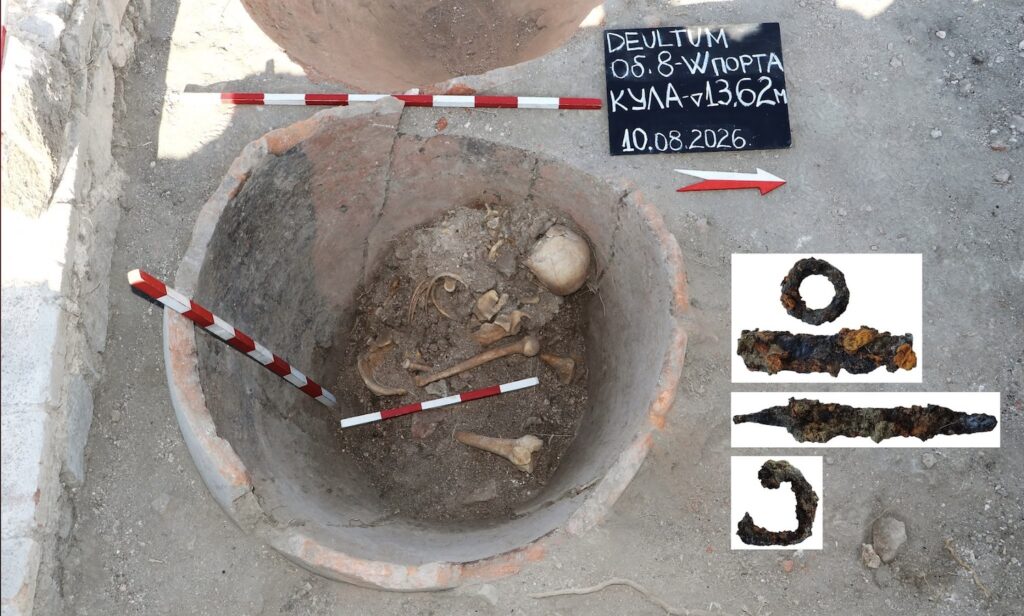
The reported find included human remains, a large storage vessel, and iron knives. Image: Archaeologia Bulgarica via the Archaeological Institute of America.
A fire was already burning
The most important clue may be beneath the skeleton.
Archaeologists found ash under the remains. This detail has shaped the current interpretation of the scene.
If the ash was already present when the man entered the dolium, he may have climbed inside after the fire had begun. He may have been trying to escape smoke, flames, falling debris, or attackers moving through the tower.
Other evidence supports the presence of an intense fire:
- Ash and charcoal around the vessel
- Blackened walls
- Melted glass
- Heat-damaged bronze coins
- Burned animal bones
- Destruction across the defensive structure
The thick ceramic walls of a dolium might have appeared to offer protection. The jar was partly set into the floor, making it lower and more concealed than the surrounding space. From inside, the man may have hoped to avoid detection or shelter from the heat.
But a storage jar could also become a trap.
Smoke may have entered the vessel. Heat could have built up inside the confined space. The surrounding structure may have collapsed or sealed the opening. At present, archaeologists cannot say with certainty whether the man died from suffocation, heat, smoke inhalation, structural collapse, or a combination of causes.
The skeleton is now being analysed in Sofia. Physical anthropology and forensic study may reveal more about his age, health, injuries, and the condition of the bones at the time of death.
The last moments in the tower
The exact sequence of events can never be recovered completely, but the evidence allows archaeologists to propose a cautious reconstruction.
Around AD 400: A city under pressure
Deultum was a fortified Roman settlement during a period of increasing raids and political instability. The western gate formed part of the city’s defensive system.
The attack or catastrophe begins
A destructive fire spread through the gate area. Whether the fire was caused directly by attackers or by another event connected with the assault remains uncertain.
The man seeks shelter
With ash already present, the young man appears to have climbed into the giant dolium. His knives went with him.
The hiding place becomes a prison
The fire continued around the vessel. Smoke, heat, or collapsing material may have prevented his escape.
The ruins are levelled
After the destruction, the remains of the tower were levelled. A new, higher floor was laid over the ruins. That later rebuilding helped preserve the vessel and the skeleton beneath it for roughly 1,600 years.

AI-generated historical reconstruction based on the archaeological interpretation. It is not an authentic image of the event.
Why was the skeleton left inside the jar?
This is one of the most intriguing questions.
The discovery does not appear to be a normal Roman burial. There is no indication that the vessel was intentionally used as a grave after the attack. Instead, the skeleton seems to have remained where the man died.
That may mean the settlement was abandoned, damaged, or too disrupted for the dead to be recovered immediately. Later residents may have known that people had died in the tower but simply covered the ruins while rebuilding.
The new floor is especially important. It suggests that the site was not destroyed and forgotten forever. At some point, people returned and made practical decisions about the damaged structure. They cleared, levelled, and rebuilt over the destruction.
For them, the dead man may have been part of a recent catastrophe. For modern archaeologists, that same decision created an unusually direct record of a crisis.
What the discovery can: and cannot: tell us
The jar provides a dramatic story, but responsible archaeology requires caution.
It is reasonable to say that the young man was probably hiding or seeking shelter. His crouched position, the storage vessel, the ash beneath him, and the surrounding fire damage all support that interpretation.
It is also reasonable to connect the event with a violent period of raids affecting Late Roman settlements in the Balkans.
But several details remain unconfirmed:
- The man’s exact age
- His occupation or social status
- The precise cause of death
- The identity of the attackers
- Whether the attack was specifically carried out by Huns or East Germanic groups
- Whether he died from smoke, heat, collapse, or another cause
Archaeologists are still analysing the remains and the wider excavation context. Future study of the bones, metal objects, coins, building layers, and dating evidence may change the current interpretation.
That uncertainty does not make the discovery less fascinating. In fact, it shows how archaeology works: a compelling story can emerge from physical evidence, but every part of that story must remain open to testing.
A forgotten history story made personal
Large historical events are often described through rulers, armies, and borders. But the skeleton at Deultum brings the late Roman world down to one human scale.
He was not named in an inscription. No ancient writer recorded his final moments. We do not know whether he was a soldier, a resident, a worker, or someone who had taken refuge in the fortress during the attack.
We know only that a young man was caught in a moment of danger, carried two iron knives, entered a giant storage jar, and died there as the surrounding tower burned.
That small set of facts is enough to make the past feel startlingly close.
The discovery is one of those fascinating historical facts that turns an ancient site into a scene of human experience. Deultum was not simply a Roman colony marked by walls and foundations. It was a living city where people faced fear, made decisions, and sometimes vanished into the archaeological record without leaving their names behind.

AI-generated reconstruction of modern archaeological excavation. It is not an authentic excavation photograph.
Why it matters today
The Deultum discovery matters because it captures the human cost of instability.
Around AD 400, the Roman Empire was still powerful, but its frontiers were under pressure. Fortifications could be strengthened, cities could be rebuilt, and armies could be sent to defend important routes. None of that guaranteed safety for the people inside the walls.
The man in the dolium represents the civilians and lesser-known inhabitants who rarely appear in written histories. His story also demonstrates why ancient archaeology remains so important. A single vessel, a layer of ash, and two iron knives can reveal more about an individual crisis than a grand summary of imperial politics.
The interpretation is preliminary, and further research may answer some of the remaining questions. For now, the evidence suggests a desperate last stand in a Roman gate tower: a hiding place that became a tomb.
Sources and further reading
- Archaeological Institute of America: Human Remains Found in Jar at Roman Fort in Bulgaria
- Bulgarian National Radio: Deultum, the oldest Roman colony in Bulgaria
- Ancient Bulgaria: Deultum archaeological site
- Visit Bulgaria: Roman town of Deultum
What do you think happened inside the tower; and would you have trusted a giant storage jar as a hiding place during an ancient attack?
Categories/Tags: Ancient Archaeology, Roman Empire, Forgotten History Stories, Ancient Civilizations Mysteries, Bulgaria
Meta description: In 2026, archaeologists found a young man’s skeleton inside a giant Roman dolium at Deultum, Bulgaria. Ash, fire damage, and two iron knives reveal a possible last stand around AD 400.